
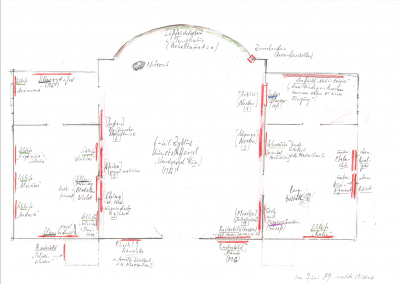
Athanor—the ensemble of works presented in Venice and named after the alchemical furnace intended to yield the philosopher’s stone via transformations of matter—reveals the full Polke cosmos: Polizeischwein (Police Pig), created using the raster technique which Polke has been known for since the 1960s, greeted visitors on the exterior wall of the German pavilion’s monumental Nazi-era building, while the painting Hände vorm Gesicht (Hands in Front of Face) flanked the entrance. Inside the historically charged exhibition space, visitors encountered new works and series created specifically for the site: in addition to six large-scale abstract paintings made with glossy synthetic sealant—the so-called mirror or lacquer paintings which reflected the exhibition space with its visitors—the artist created an abstract, gestural mural in the apse of the pavilion with salt-based pigment that responded to the atmosphere of the Venetian lagoon, shifting from a delicate blue to a bright pink depending on the humidity.
Athanor Now
Sigmar Polke: Athanor NOW
40 years after the celebrated presentation of Sigmar Polke’s Athanor installation in the German Pavilion at the 1986 Venice Biennale, Sigmar Polke: Athanor NOW reactivates this now-iconic constellation of works from current artistic and scholarly perspectives. The program focuses on topics such as ecology, alchemy, materiality, politics, and technology.
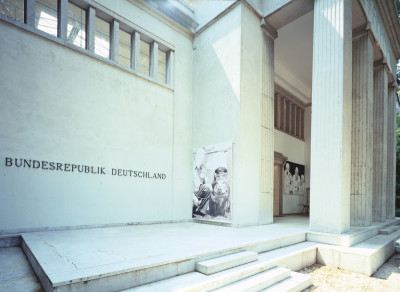
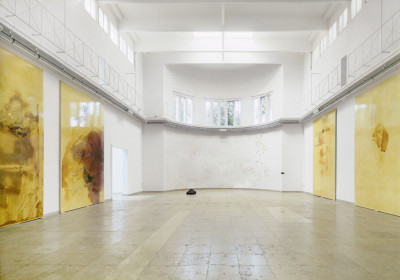
Polke extended this manifestation of the natural forces at play by positioning naturally occurring objects—a cinnabar stone, a quartz crystal, and a meteorite—within the space. Other paintings incorporated natural pigments and earth colors as well as synthetically produced materials, lacquers, and resins, some of which were toxic. The abundance of materials clearly demonstrates Polke’s joy in experimenting with the widest variety of substances, supports, motifs, and objects.
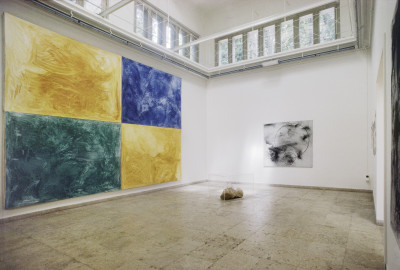
In the Dürerschleifen (Dürer Loops) group of paintings, he transferred elements from a 1523 woodcut by Albrecht Dürer onto canvases dusted with graphite powder. In the four monochrome Farbtafeln (Color Panels) onto which Polke sprinkled and spread pure, partly toxic pigments, the colors and materials themselves became the subject of the image. The artist’s deep interest in the transformation of matter—and of paint in particular—is also revealed in the elaborate painting process behind Purpurtuch (Purple Cloth), a light silk textile partially painted with ornamental forms. The traces of Tyrian purple dye, which Polke extracted himself from the secretion of murex snails, only take on their full color in sunlight and undergo transformations during application and the subsequent drying process.
With the image of the alchemists‘ furnace, Polke found a complex and flexible form that brought his painting together with the architecture of the pavilion and its immediate surroundings, and with natural and cultural-historical themes. He referred to current events—such as the handling of German (Nazi) history or the effects of the devastating explosion of the nuclear reactor in Chernobyl, which occurred in April 1986 while Polke was preparing for Venice—and thus transformed the pavilion into a political blast furnace. These references are exemplary of Polke's unconventional, reflective, and at the same time non-hierarchical approach to materials, colors, and media.
The Biennale installation marks a pivotal moment in Sigmar Polke's oeuvre. The works created in the 1980s play a special role in his entire oeuvre because the artist began painting in a completely new and different way than before: he tried out unusual materials and colors, experimented, and developed new painting techniques. He was interested not only in the contexts associated with the materials themselves–such as former imperial colors like vermilion and lapis lazuli, or synthetically produced and essentially art-foreign substances like cobalt chloride–but also in the effects of the materials, such as the reactivity of silver compounds with light. The result is multi-layered works, some of which continue to change and transform over time, thus revealingthe painting as a work in progress. Polke came to be regarded as an alchemist after the Athanor installation, which won him the Golden Lion.
In offering a fresh perspective on this particularly productive phase during the 1980s, the project Sigmar Polke: Athanor NOW expands the artist’s reception as an alchemist.
Artists and researchers from various disciplines will pick up on aspects of the historical constellation of Polke works and connect his engagement with diverse contexts and materials to current issues in practice and theory. Culture-historical approaches will thus be enriched by perspectives from literature and philosophy, the digital humanities, and the natural and technical sciences.
Through a major solo exhibition at the De Pont Museum in Tilburg, a summer school and numerous formats—including guided tours and collection interventions, university courses and workshops, educational programs, podcasts and digital offerings—the international year-long program reactivates works from the multilayered installation and related pieces within contemporary contexts. Situated between scholarly research, artistic interaction, and public discourse, Sigmar Polke: Athanor NOW traces the influences emanating from Polke’s thinking and making, which—forty years after the presentation in Venice—acquire relevance today in the form of new constellations.