In 1970, the journal Der Wegweiser published an article in which Sigmar Polke reflected on his artistic work in light of contemporary information theory, using an almost poetic style. At first, the title only seems to concern Polke’s famous Rasterbilder, but it soon becomes clear upon reading that the artist has set out to fundamentally situate his practice. Right at the outset, he generally describes “artistic quality” as “a question of the feedback of subjective experience to objective facts”—a concept that by the end of the text culminates in terms such as “technology, communication, system, order, equality.”
“A Question of Feedback”
“A Question of Feedback”:
Technology and Umwelt in Sigmar Polke’s Athanor installation
In using the term “feedback,” Polke explicitly adopted a concept from cybernetics, whose systemic thinking coupled humans and machines, and thus the living and the non-living, in a new way.
Norbert Wiener and his colleagues’ attempt to institutionalize cybernetics in the mid-20th century is generally considered the beginning of the contemporary information age. With mathematician Claude Shannon’s theorization of information and its transmission, the young discipline of cybernetics established an analogy between the functioning of biological organisms and machines, thereby making the behavior and relationships of complex organizational structures mathematically describable. By drawing parallels between his artistic practice and the systemic thinking of cybernetics, Polke—and this is the thesis—shows an early openness to environmental thinking in his artistic approach. While this may seem like a large claim to make in relation to the Rasterbilder, the Athanor installation explicitly addresses ecological issues, as evidenced by the moisture-sensitive hydro-painting on the wall.
In this seminar, we will examine the Athanor installation from the perspectives of the history of technology and materials, as well as art and media studies, in order to analyze this alchemical furnace in relation to contemporary questions. The seminar is a collaborative project between the Department of Literary Studies at TU Berlin and the Department of Art History and Historical Image Studies at Universität Bielefeld. Together with students from both institutions, the interdisciplinary seminar aims to explore the history of knowledge as well as technical and information-theoretical discourses, which very early on in Polke’s work reveal a concept of art production that abandons the idea of the ingenious creator in favor of a complex network of feedback effects between humans, nature, culture, and technology. As a body of work, Athanor is embedded in material-aesthetic processes (earth colors, natural pigments, and synthetically produced lacquers and resins), technical processes (Rasterbilder), and site-specific processes (wall paint that changes according to humidity), all of which interact with one another.
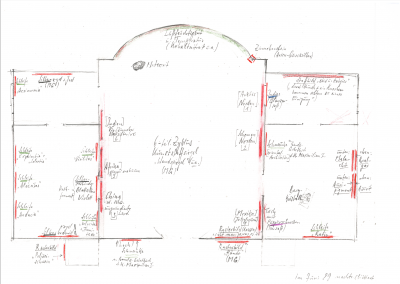
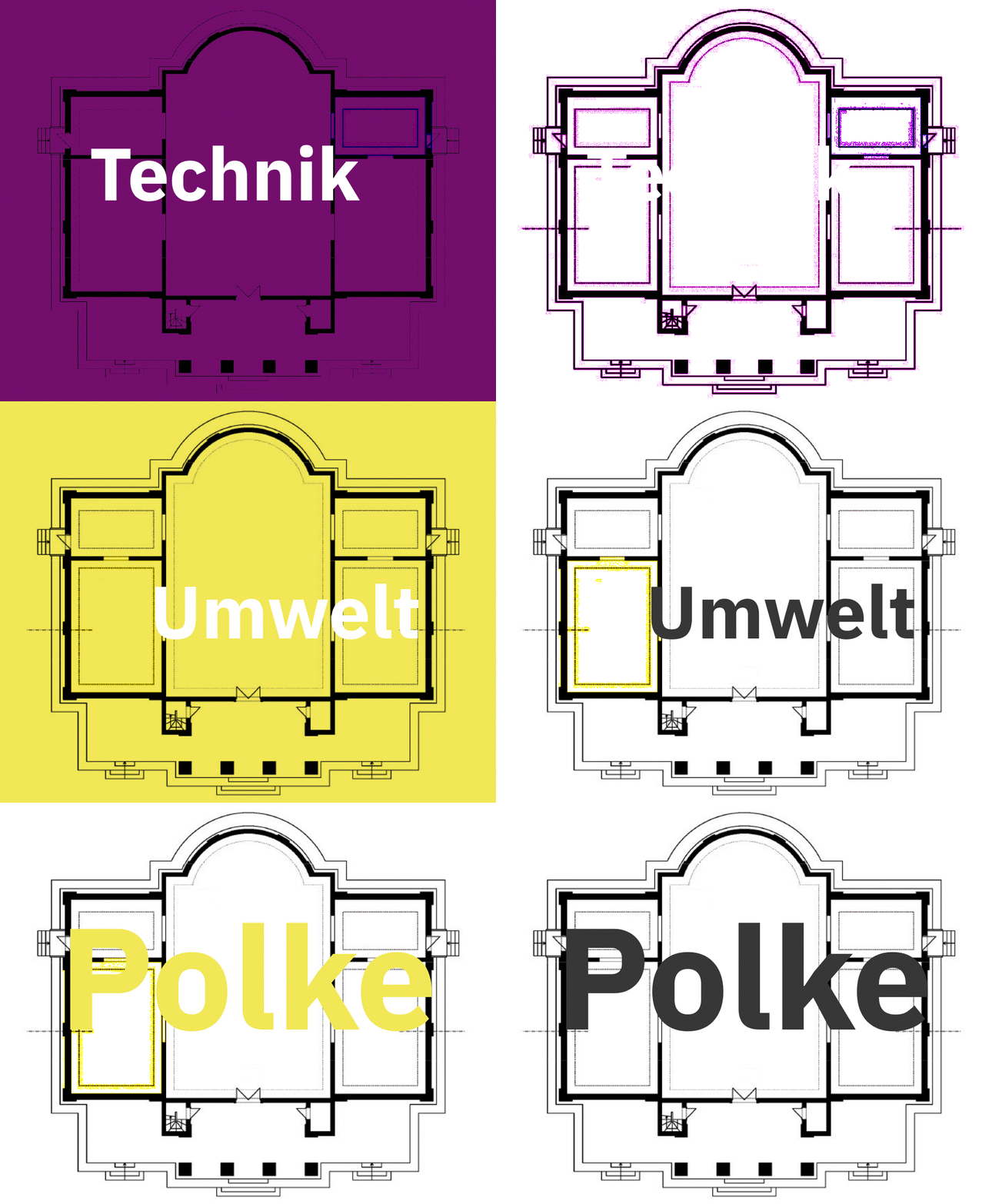
To make this network visible, a digitally accessible archive will be created as an outcome of the collaborative seminar work. Users will be able to access the seminar project page, which displays the pavilion’s floor plan, via the general website Sigmar Polke: Athanor NOW. By linking thematic focuses across different levels, the page will visualize connections within Polke’s work and reveal their relevant theoretical contexts. Starting in the winter semester of 2026/2027, this network structure will be filled with multimedia content (images, text, audio) developed collaboratively in the seminar. Users will then be able to navigate between works in different contexts and make their own connections. The seminar focuses on archiving contemporary engagement with the original installation and uncovering its historical and epistemological contexts.
“A Question of Feedback”: Technology and Umwelt in Sigmar Polke’s Athanor installation
Seminar, led by Daniela Doutch and Aurea Klarskov, winter semester 2026/2027, TU Berlin; Universität Bielefeld; Universität der Künste Berlin