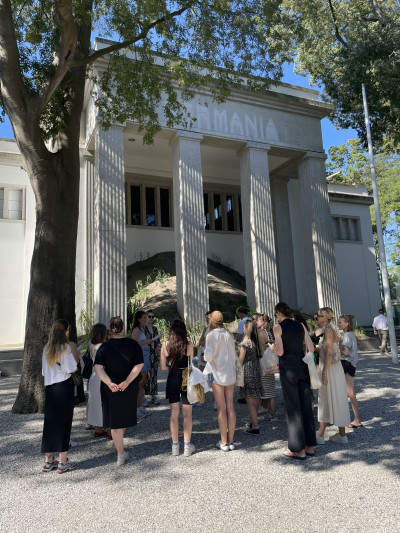
With his contribution to the 1986 Biennale, Sigmar Polke transformed the German pavilion into a giant alchemical furnace, a so-called Athanor. His presentation not only demonstrated the changing physical states of solid and volatile substances (solve et coagula), but also how they were determined by the environmental conditions. The art would constantly shift its appearance according to the humidity of the lagoon and functioned as a dynamic energizing element that transformed the pavilion’s massive and ossified Nazi architecture. The work was thus a catalyst, actively influencing its surroundings and subjecting them to a constant process of transformation. But how far does the transformative power of art extend into society? Can works of art change not only spaces and viewers, but also political conditions? Is art even a catalyst for democratic processes? During an intensive study week (as part of the Master’s program in Art Education and Cultural Management at Heinrich-Heine-Universität Düsseldorf), we will analyze selected contributions to the national pavilions with regard to their transformative potential, in whatever form, and examine their underlying conceptions of art. What happens to art’s much-cited freedom when it is presented in national pavilions conceived as instruments of state representation, both historically and today? Which determining conditions are the works subject to? And how do the artists themselves influence their environment?
Art and Politics at the Venice Biennale
Art and Politics at the Venice Biennale
Art and Politics at the Venice Biennale
Excursion, 06.–10.09.2026, Venice
Organized by Ulli Seegers as part of the Master’s program in Art Education and Cultural Management at Heinrich-Heine-Universität Düsseldorf.