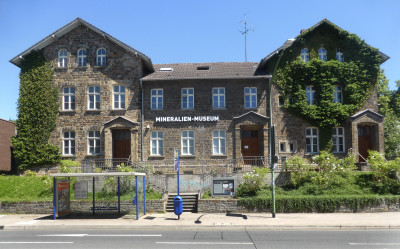
The evening event “Is there a stone that smells of death?” is combined with a guided tour of the Mineralien-Museum and marks the start of the diverse Athanor NOW projects at this location in Essen-Kupferdreh. In three chapters, geologist Ulrike Stottrop addresses the questions Sigmar Polke posed to nature in general and specifically to the natural objects in the collection of the Ruhr Museum (formerly Ruhrlandmuseum) during his visit in June 1986. The exchange in front of the exhibits was inspiring for both sides and is reflected in the guided tour of selected objects from the collection that relate to Polke's own works.
"Is there a stone that smells like death?"
Polke's inspiring visit.
Geologist Ulrike Stottrop's memories of Sigmar Polke
Chapter 1
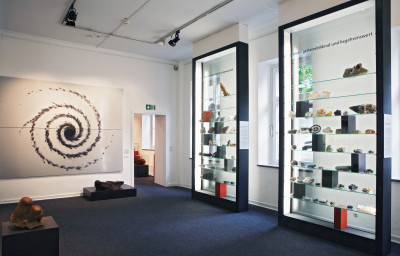
"Is there a stone that smells of death?" Memories of Polke's visit to the Mineralien-Museum
Registration details and further information about this event are available here.
Chapter 2
"Connecting everything to everything" Polke's search for knowledge in materials, processes, and manifestations of nature
Chapter 3
"Conjuring humanity across vast distances of time and space" Meteorite and quartz crysta as carriers of meaning
Ulrike Stottrop, geologist, worked at the Ruhrlandmuseum / Ruhr Museum from 1984 until her retirement in 2019, where she was deputy director, head of the natural science collections, and, from 1985, director of the Mineralien-Museum, which opened in 1984 as a collaborative project with the Kupferdreher citizens. In this capacity, she was responsible for the loan of the meteorite and quartz crystal.
Polke's visit to the Ruhrlandmuseum / Ruhr Museum took place on 3 June 1986, shortly before the opening of the Venice Biennale on 29 June 1986. The occasion was a viewing of the meteorite and quartz crystal shortly before their transport to Venice, where they were exhibited as part of Polke's Athanor installation in the German Pavilion. The quartz crystal was still in the Mineralien-Museum, as was a second meteorite that was not considered for Venice but was filmed by Polke. Time was running, yet Polke showed great interest in various minerals.
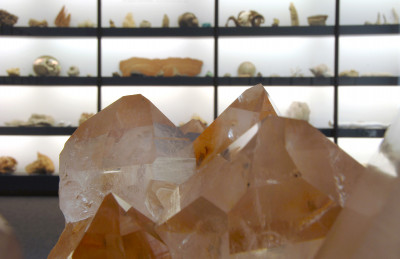
He was particularly interested in a collection of backlit agate discs and the reference to their artificial colorability and where they could be purchased. The agate windows in Zurich's Grossmünster church are likely to have originated here.
Controversial topics such as environmental pollution from heavy metals and the handling of nuclear waste were also addressed during the exchange with Polke: a display case containing radioactive minerals provided an opportunity to discuss their radiation potential. Chernobyl had occurred on 26 April 1986.
Based on her own memories of her encounter with Sigmar Polke, Ulrike Stottrop provides special insights into the genesis of the Athanor installation. The evening event with guided tour addresses art-historical, environmental-geological, material-technical, and socio-political aspects as well as health aspects, allowing a completely new approach to Polke's approach and work.
Polke's inspiring visit. Geologist Ulrike Stottrop's memories of Sigmar Polke
Lecture, Guided Tour and Talk, 14 June 2026, 6–7.30 pm, Mineralien-Museum, Essen-Kupferdreh