The study day examines current evocations of danger through art by drawing on Polke’s ironic material politics. It focuses on continuities and ruptures from the 1960s to the present day with regard to the aesthetic and ‘political’ needs of an audience attuned to experiential aesthetics. How marketable are the effects of danger? What distinguishes art that claims to contaminate? How is art reflected that contaminates not an audience but other artworks?
Contaminated Art?
Contaminated Art?
From Polke’s Material Politics to Danger as an Artistic Strategy
Sigmar Polke (1941–2010) was known for his use of irony, through which he sought to dissolve the boundary between trivial and high culture—in terms of both content and material: With his contribution Athanor to the Venice Biennale in 1986, for example, he created a dynamic exhibition situation in which the colors he applied changed due to temperature, humidity, and the exhalations of the audience. These processes also functioned as tongue-in-cheek comments on the emerging tendencies for mysticism and cosmology in the 1980s between New Wave, escapism, and new forms of nature spirituality. In addition to wall paintings, Polke deliberately presented heterogeneous elements in Athanor: an iron meteorite, a quartz crystal, the Schleifenbilder series, and several lacquer and grid paintings. Since the 1960s, he had also been experimenting with an arsenal of unusual, sometimes highly toxic chemicals—lacquers with hallucinogenic effects, silver nitrate, potassium permanganate, radioactive rock, and lead-based paints. One anecdote even claims that Polke wanted museum visitors to lose their hair while viewing his artistic works—due to radioactive exposure or chemical fumes. This kind of irony and delight in ambivalence—in the choice of materials as well as in art and exhibition making—generally characterized the art of the 1960s and 1970s and can pose problems not only for conservators and curators. In the context of ecological and social debates, which are increasingly shaping the current art scene, other ways of dealing with risk and danger have emerged: artists now work directly with contaminated materials, such as radioactive substances or in toxic regions, in order to provoke reflection of specific problems and generate concern. Others deliberately stage danger and contamination in immersive ways. However, the materials used in such works are precisely characterized by their harmlessness and thus merely simulate danger: they work directly with associations of disgust and thus respond deliberately to a contemporary culture preoccupied with individual concerns and needs—illness, therapy, detoxification, and healing, but also pleasure.
The study day will address various dimensions of danger in and through art, by drawing on Polke’s material politics.
With a focus on positions in contemporary art, strategies for negotiating risk and contamination will be analyzed and critically historicized. What aesthetic, cultural, thematic, and “political” needs of museum audiences do these works generate or address—for example, with regard to the marketable, accelerated availability and comprehensibility of art? What role do irony and the resulting ambivalences play in today’s artistic positions vis-à-vis the impulse toward didacticism and the clarification of problems? How does the simulative “as if” of exhibition situations relate to real dangers to the audience? What forms of maintenance or attention do artworks marked as “contaminated” demand, and what understanding of care do they articulate in turn? How is art reflected upon on that actually contaminates other artworks and exhibition spaces? Consequently, are today’s artistic practices—grounded more in effect, emotion, and media dissemination—in some ways opposed to the material legacy of the 1960s and 1970s?
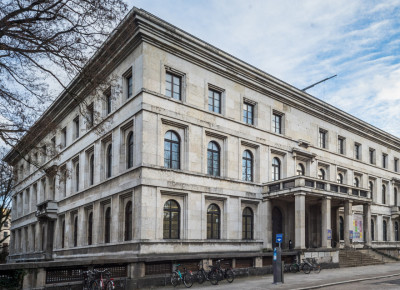
Contaminated Art? begins on March 25, 2026, with an evening lecture by Julia Gelshorn (Fribourg). The following study day, March 26, 2026, will feature contributions regarding the interrelation between exhibition and contamination: Kyveli Mavrokordopoulou (Amsterdam) and Lotte Arndt (Paris), who examine art as a contaminated or contaminating practice; by Lilian Haberer (Cologne) and Barbara Oettl (Cologne), who explore artistic strategies that simulate contamination; and by Charlotte Matter (Basel) and Angela Matyssek (Dresden), who investigate art’s engagement with contaminated materials. The two-day event is organized by Linn Burchert (Munich), Michael Klipphahn-Karge (Leipzig/Munich), and Friederike Schäfer (Berlin).
Contaminated Art? From Polke’s Material Politics to Danger as an Artistic Strategy
Study day, 25 and 26 March 2026, Zentralinstitut für Kunstgeschichte, Munich and online
zikg.eu/aktuelles/veranstaltungen/2026/studientag-kontaminierte-kunst