Art lives from art. The copying and transforming of artistic predecessors has been part of art history since its very beginning. Aby Warburg spoke of “the migration of images,” while Andreas Beyer coined the term “interpictoriality.” In his multilayered oeuvre, Sigmar Polke repeatedly drew on Albrecht Dürer, undertaking a shift in medium every time.
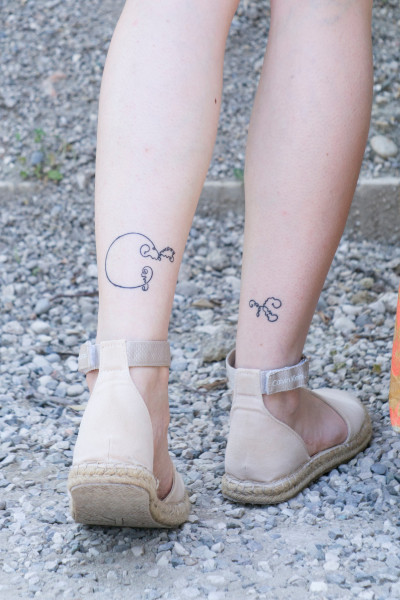
500 years after Dürer, his work is now more than ever a source of inspiration for artists around the world working in a wide variety of media and techniques. In tattoo art as well, Dürer has become a frequently cited figure since the emergence of the so-called engraving or woodcut style about 15 years ago. Much like Sigmar Polke, tattoo artists take individual motifs from Dürer’s visual stockpile and modify them. These transformative artistic quotations develop a life of their own. They transform the human body and are, in turn, transformed by it. In that sense, the metaphor of the Athanor invoked by Polke also applies to the tattooed body.
The human body emerges as a living image carrierand becomes part of the artwork. This merging of people and images could also be experienced in a different way in Polke’s reflective installation from 1986. Adults will be able to get a small tattoo based on designs by Dürer and Polke.
Further information can be found here.