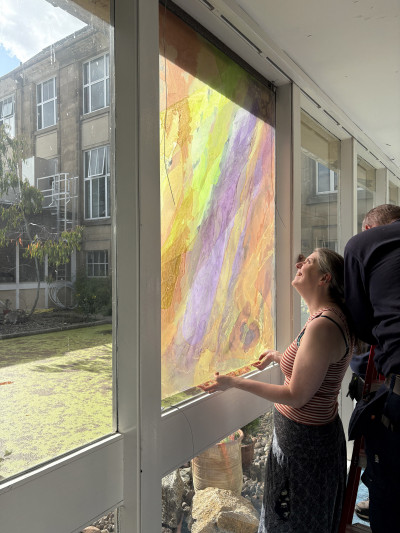
These public artworks will be accessible to view in person at the Cockburn Geological Museum, online, and in an associated publication. The pigments featured in both parts of the installation are associated with the Cockburn collection (serpentine, amethyst, and calcite), along with locally sourced pigments including sandstone, algal biofilm and anthropogenic materials like carbon soot abraded from buildings, and orange shale oil waste materials from West Lothian. Blue mussel shells from the Portobello coastline are ground into powder and used within the tufa chemistry. The integration of anthropogenic, biogenic, and geological pigments reflects the everyday alchemy of more-than-human transformation within our urban geology and post-industrial sites.
Naturally occurring tufa is a kind of limestone, formed when calcium-rich water flows over soil and biological matter and interacts with carbon dioxide from the air, highlighting the interrelated nature of biological and geological processes. Anthropogenic tufa forms in post-industrial sites where calcium and other contaminants have leached into ground waters. This form of tufa has been found in post-industrial situations in Scotland and elsewhere in the United Kingdom, where eroded waste deposits generate hard water that then petrifies living matter while also sequestering water contaminants and carbon dioxide (Marta Kalabová, 2022; 2024).
To create the anthropogenic tufa fresco, a gravity system will cast calcium-rich water over pre-formed bacterial polyester scaffolds that operate like an armature on which the fluid will gradually calcify. Bio-based paintings will interweave with the precipitate, acting as additional scaffolding and enclosing layers of artwork within the accumulating tufa.
This collaboration applies the science of tufa formation within a painterly time-based geological model. The tufa fresco has the potential to function as model that materialises and records the evolving climate-changing concentrations of atmospheric CO2. This tufa system also mimics and expands the geochemistry of fresco painting, with calcification of paint occurring in 3D over time and in response to atmospheric conditions.