Forty years after Sigmar Polke’s Athanor installation in Venice, the works from that presentation are now dispersed across various collections: the loop paintings Dürer Schleifen belong to the Bayerische Staatsgemäldesammlungen, while the rock crystal and the meteorite have (once again) become part of the collection at the Mineralien-Museum in Essen. The wall piece painted with salt-based pigments remained at its original site, and six lacquer paintings entered the collection of Museum Abteiberg in Mönchengladbach. Already in Venice, Polke placed the interplay of minerals, crystals, and experimental techniques at the center of his practice. He explored the relationships between natural materials, artistic transformation, and symbolic charge—a synthesis of materiality, scientific curiosity, and poetic imagery that continues to serve as a key reference point for my own artistic work.
Scenario for a Crystal
Stefanie Pluta, Scenario for a Crystal
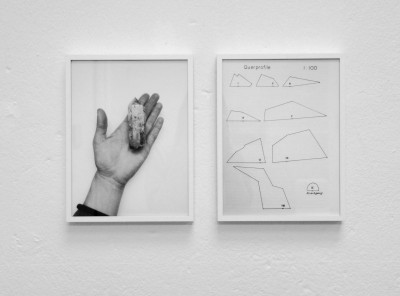
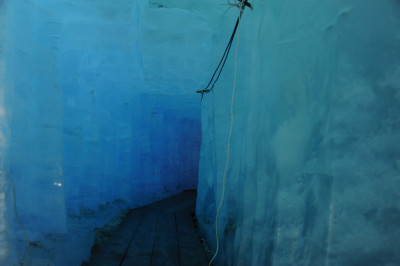
As part of a studio residency in 2014, I spent three months in the Swiss Central Alps researching the history of the so-called Indergand Crystal—a harmoniously proportioned smoky quartz cluster discovered in 1946 at the Tiefengletscher by the owner of a crystal trading company in Göschenen. Following the trail of this crystal, I examined questions of materiality, appearance, and texture, as well as symbolic meaning, geographic location, and museological presentation.
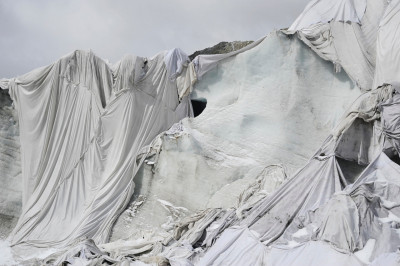
The journey of crystals must also be viewed critically: from their geological origins through industrial extraction and global trade to their museal or artistic display—a movement between nature, commodity, and symbol. Scenario for a Crystal explores the complex human relationship to these natural objects—between admiration, appropriation, and museological representation.
As part of the exhibition at Istituto Italiano di Cultura di Colonia, cyanotype workshops will accompany the presentation. The cyanotype is a historical photographic process in which light-sensitive material is contact-exposed without the use of a camera, producing photograms through the direct exposure of objects on a coated surface. This early technique is characterized by its experimental openness: variables such as exposure time, light intensity, and chemical composition strongly influence the result, rendering each print unique. The workshops focus on experimentation, the conscious surrender of control, and engagement with processes whose outcomes cannot be entirely predetermined.
Stefanie Pluta, 2025
Further information about the exhibition in German or Italian language can be found here.
Stefanie Pluta, Scenario for a Crystal
Exhibition, 13 July–20 November 2026, Istituto Italiano di Cultura di Colonia, Cologne
Opening: 10 July, 7 pm
Opening hours: Monday–Thursday, 9 am–1 pm and 1.30–5 pm; Friday: 9 am–2 pm