Sigmar Polke: The Knowledge of Colors

Sigmar Polke: The Knowledge of Colors

Based on Sigmar Polke’s (1941–2010) color experiments of the 1980s, the exhibition Sigmar Polke: The Knowledge of Colors takes a look at his captivatingly beautiful and color-intensive paintings as well as the material transformations involved. The works on display cover three decades of his career and testify to a precise yet playful approach to colors and forms. This multi-layered creative process showcases Polke’s profound understanding of painting as an open and permeable artistic practice.

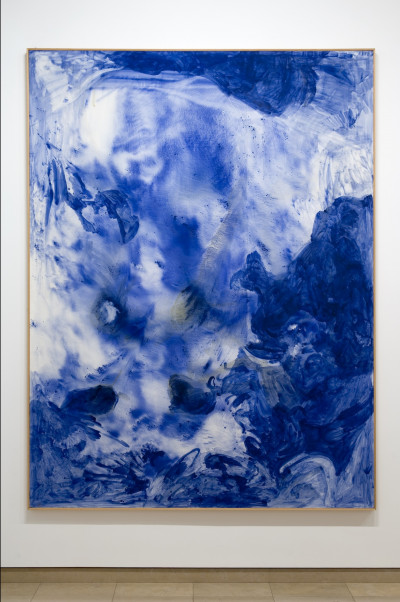
Sigmar Polke, Hermes Trismegistos III and IV, 1995, De Pont Museum, Tilburg | © Photo: Peter Cox, © The Estate of Sigmar Polke / VG Bild-Kunst, Bonn

Hermes Trismegistos I–IV (1995), a four-part group of works in the De Pont Museum collection, forms the core of the exhibition in dialogue with eight monochrome Farbtafeln (Color Panels) from 1986/87 and 1992 from the Stedelijk Museum collection, raising questions about Polke’s painterly work and the associated knowledge of colors. The exhibition then proceeds from the early Farb- und Materialproben (Color and Material Experiments) of the 1980s to the late, luminous interference paintings of the 2000s. Light and transparency, movement and transformation, as well as the cultural and political context of materials, pigments, and minerals play a particularly important role here.

The depiction of the mythical figure Hermes Trismegistos, understood as the founder of alchemy and the transmitter of hieroglyphics, shows how knowledge has been conveyed over centuries in different cultures, media, and formats.
With the concrete image motif of Hermes, Polke cites a historical image from a floor mosaic in Siena Cathedral, which he enlarges and fragments onto transparent image carriers. The way in which colors and forms relate and combine with each other in the group of works demonstrates the complex artistic use and specific application of colors and materials in Polke’s work.

The ensemble also reveals aspects that transcend the conventional alchemical interpretation of Polke’s painting. The paints, varnishes, and pigments used are conceived as actors in the pictorial narrative since they trigger movements and influence each other. And as such, the power of agency is transferred from the artist to the paints and materials.

Tracing the histories and contexts of natural and synthetic materials and substances, as well as the chosen motifs, reveals direct connections between the histories of culture, art, and nature.

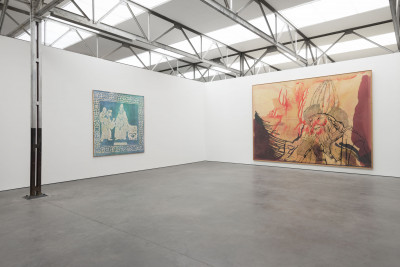
De Pont Museum Tilburg | © De Pont Museum Tilburg, Photo: Jasper Loeffen

The works on display mark a turning point in Sigmar Polke’s oeuvre, which can be traced back to a long journey that took him to Australia, Papua New Guinea, and Southeast Asia in 1980/81. This trip fundamentally transformed his work and his view of (the contexts of) colors. The significance of this painterly transformation was first revealed in 1986 at the Biennale di Venezia in the German Pavilion, where Polke presented his Athanor installation, which was awarded the Golden Lion. This now iconic exhibition, characterized by constant change and a transformation of material, color, and light, cemented Polke’s reputation as an alchemical artist, which had been established since the early 1980s. The works of this period were often made by pouring, casting, blowing, sprinkling, and brushing lacquers, pigments, and resins onto transparent or semi-transparent image carriers, fabrics, or canvas. These include entirely abstract Farbproben (Color Experiments), Lack- oder Schüttbilder (Lacquer or Pouring Paintings), as well as works with clearly identifiable figures and forms from visual sources, including quotations from art and cultural history.

The abstract color compositions and painterly details demonstrate a fundamental questioning of a supposedly well-defined painting canon, as Polke plays with the intermediality of the works and consciously incorporates space, transparency, and light into the composition and creation of the images.

The material and thematic complexity of the paintings in Sigmar Polke’s multimedia oeuvre continue to exemplify how experimental and, in some sense, transmedial his artistic approach was. Focusing on color, the exhibition at the De Pont Museum brings together over 50 paintings by the artist for the first time, ranging from the early 1980s to his late works from the 2000s, thus providing a thematically focused yet broad overview of Polke’s painterly oeuvre.

Sigmar Polke: The Knowledge of Colors
Exhibition, 19 September 2026–28 February 2027, De Pont Museum, Tilburg

A joint exhibition by De Pont Museum and Anna Polke-Stiftung.
Curators: Kathrin Barutzki (Anna Polke Foundation), Martijn van Nieuwenhuyzen, and Maria Schnyder (De Pont Museum).