
Troubling Pigments (After Polke) explores the ecological, colonial, and social histories of pigments. Taking as its point of departure the eight pigments used in the eight monochrome paintings of the Farbtafeln (Color Panels, 1986–92), part of the Stedelijk Museum Amsterdam’s collection, the project brings together a group of alumni from the Rijksakademie and Kyveli Mavrokordopoulou (curator, lecturer, and researcher, art history and environmental humanities, Vrije Universiteit Amsterdam) to examine pigments as part of larger stories of trade, illness, colonialism, and environmental violence. The project will culminate in a public presentation at the Rijksakademie.
Troubling Pigments | Diaries
Troubling Pigments (After Polke) | Diaries
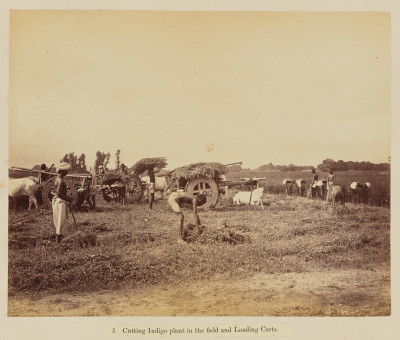
This blog documents the research group's interdisciplinary approach and presents initial findings.
______________
I. Instead of an editorial
Meeting 1
February 24th Rijksakademie Amsterdam
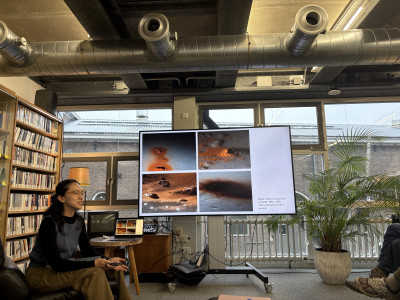
In the last week of February 2026, the inaugural meeting for the artistic research project Troubling Pigments (after Polke) took place at Amsterdam’s renowned artist residency institute, the Rijksakademie. The selected artists—Fransisca Angela, Juan Arturo García, and Müge Yilmaz—joined art historian, curator, and environmental humanities scholar Kyveli Mavrokordopoulou for a series of conversational presentations to begin to explore and establish the direction of research in considering pigments as part of larger stories of trade, illness, colonialism, labour, and environmental violence. This initial conversation was also joined by the technical specialist of the Paint Workshop, Arend Nijkamp, who will support and collaborate with the artists, and Sandra Felten, who is in charge of bureau alumni at the Rijksakademie.
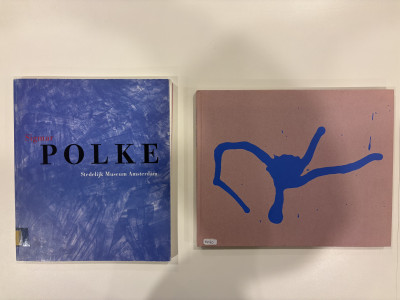
Mavrokordopoulou began by presenting the 1986 German pavilion to the group. Besides introducing the space and constituents of Athanor, Mavrokordopoulou foregrounded Sigmar Polke’s affinity with themes of toxicity and radioactive substances—her own principal research interests—evident in works such as Uranium Green (1982). Accompanying her presentation of Polke’s biennale solo was a copy of the exhibition’s catalogue, a rare object that is better described as an artist book. Eschewing the traditional format of artwork documentation, the ethereal images that populate it capture curious details, shadows, and angles of the pavilion prior to the show’s erection, viewed through the hazy effects of the processing Polke deployed. As we sat, paging through, the photographs reminiscent of experimental chemistry, digital slides on the presentation screen depicting the crystalline rocks that are central to this artistic research project drew our eyes with their hues.
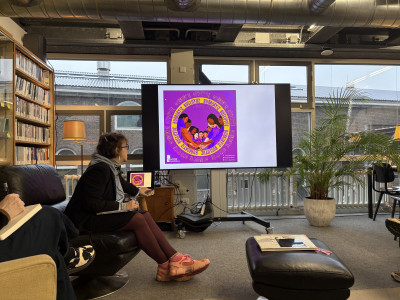
This set the scene for each of the participating artists to introduce their own research ideas surrounding Athanor and the series of Farbtafeln that are part of the Stedelijk Museum Amsterdam’s permanent collection, which followed Polke’s monochrome paintings of pure pigments from the biennale. Troubling Pigments (After Polke) departs from this second series of large-scale colour field works and, although fluid, follows thematic paths aligning with the three artists’ ideas; broadly, the interwoven issues of toxicity, labour and material origins. Fransisca, García and Yilmaz each shared some of their artistic background, situating their project proposals as well as intimating what kinds of knowledge might aggregate during the process.
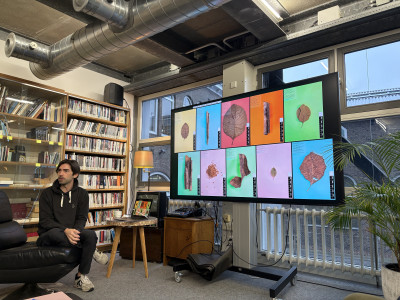
Each artist will work independently while also partaking in field trips together with Mavrokordopoulou and others, in pursuit of tracing (im)material histories involving pigment sourcing and production, colonial antecedents, and the cultural, ecological, and political aspects of art making. The upcoming research will explore how pigments offer traversal through the gender politics of (art) labour, how material and colour move across various epistemic environments, and how the same matter acquires different meanings through time and space.
Melissa Waters, Master Environmental Humanities, Vrije Universiteit Amsterdam, research intern for Troubling Pigments (after Polke)
______________
II. A (different kind of) Toxic Tour
Meeting 2
March 31st Stedelijk Depot, Amsterdam

In the midst of a business warehouse district of Amsterdam, a minimalist building is home to some of the most important modern and contemporary art and design from the western hemisphere.
This is the off-site depot of the Stedelijk Museum – a quiet workplace staffed by a tiny contingent, primarily art conservation specialists. The cohort of Troubling Pigments (After Polke) is here to meet Annegret Volk, painting conservator at the museum. Our group includes artists Fransisca Angela, Juan Arturo García, Müge Yilmaz, and Cyn Micheli, curator and art historian Kyveli Mavrokordopoulou, Rijksakademie technical painting specialist Arend Nijkamp and tech fellow Damianos Zisimou, of the painting lab, and Aquil Copier, pigment expert at Old Holland.
As we make our way into the storage rooms, a cool dim descends and electrical bulbs replace their natural counterpart. “Rooms” feels like an inadequate term; the concrete spaces we weave through are large, with a network of floor to ceiling shelving housing row upon row of large wooden crates.

We have come to see a set of Sigmar Polke’s Farbtafeln (1986–1987, 1992), which are part of the Stedelijk collection. While aesthetes would balk at the thought of encountering such works for the first time in the preserve of a storage depot, the sight of them does not fail to evoke an immediate sense of awe. They are monumental. And they are alluringly, definitively chromatic. As we hover around the entrance to the pigmental portal generated by the two facing rows of these immense colour field paintings, Volk gestures to a neat stack of surgical masks on a table. Polke painted the Farbtafeln before us with the naturally occurring pigments of various rocks and minerals, ground into a fine dust, combined with a viscous, binding substance, and gesturally applied across the support. Several of these minerals have extremely hazardous properties; and even those which are relatively benign pose dangers when pulverized, the fine silicates settling into lungs and fleshy matter.
Of course, our brief visitation likely carries little risk as Volk explains, but several of us collect a mask before approaching the works upon her suggestion. Positioned in portrait, leaning against the shelves and framed by their protective pine wood crating, they tower over us at 3 metres tall. Reiterating those exhibited as part of the Athanor pavilion, this subsequent set uses the same types of minerals. The 1986 Farben-Bilder (Colour Pictures) of the pavilion were made with ‘azurite’–a soft, deep blue produced by the weathering of copper ore, and historically related to the naming of cyan and cerulean; ‘malachite’–a close geologic relative of azurite, this copper carbonate was named for the green leaves of the mallow plant; and lastly, the toxic arsenic sulfides ‘realgar’ and ‘orpiment’–also closely associated geologically, each producing a yellow hue in the Farben-Bilder, though the former forms as a red crystal used historically as both a medicine and a poison.

The Stedelijk’s Farbtafeln (1986–1987, 1992) are each of these substances and several more–a second blue-stained canvas of ‘lapis lazuli’–that extremely precious stone the value of which surpassed gold in the middle ages, and progenitor of spell-binding ultramarine; ‘spanish green’–less of a stone and more an accretion produced when acid meets metallic copper; ‘red lead’–a poisonous, roasted form of white lead that is used, among other purposes, to manufacture batteries; and ‘cinnabar’–another vibrant red, sulphuric rock that is the most common source of liquid mercury in nature. The hydrosensitive wall painting that Polke created in the central chamber of the Athanor pavilion featured a piece of the latter scarlet-to-brick-red-hued rock embedded in the wall, covered by a protective glass case.
As we are physically confronted by the toxic compulsions of Polke’s artmaking, we learn that the binding ingredient of choice in the raw pigment paint comprising these works is fish glue. An unusual choice over the more common binders of linseed oil or gum arabic, for example, fish glue has the property of remaining fluid even in cold temperatures. Fish bodies are by necessity resistant to cold, watery depths, whereas glue made from a mammalian will tend towards solidity in the same environment, given their terrestrial lifeworlds. In discussing these intriguing details, the nonhuman forces of both lively beings and lithic compounds in artistic practice become sensible, visible. Such eco-material preconditions and associated harms form one of the central enquiries in the Troubling Pigments research project. As we examine these fields of pigment over the course of two hours, the idea that their abstraction conceals material histories of their geological geographies precipitates. Material topographies that span imperial and colonial antecedents and modern-day conflicts, encompassing successions of contamination, illness and environmental violence.
Melissa Waters, Master Environmental Humanities, Vrije Universiteit Amsterdam, research intern for Troubling Pigments (After Polke)
______________
III. Field of Blue
Meeting 3
April 15th Rijksakademie Amsterdam
In mid-April another research session was held for Troubling Pigments (After Polke) in the form of a film screening and discussion at the Rijksakademie, Amsterdam. Expanding on the issues of toxicity, industry, and material origins that ground the collective research, the team viewed selected works pertinent to questions of labour – including permutations of the artistic, domestic, and colonial.

First, we watched two films by the late German artist Margaret Raspé (1933–2023). Both were made using the "camera helmet" device she developed in the early 1970s, with which she captured self-referential imagery of domesticity. The method captures a sense of the numbing automatisms that stretch across capitalist economies and quotidian home spaces.
Der Sadist schlägt das eindeutig Unschuldige (The Sadist Whips the Unquestionably Innocent), 1971, is a point-of-view piece showing a glass of cream gradually churned to butter with the frenetic mechanics of a hand-held electric beater. Raspé made several other food related works, including preparation of a pork schnitzel – Schweineschnitzel (Pork Schnitzel), 1971 – and the gutting of a chicken in Oh Tod, wie nahrhaft bist Du (Oh Death, How Nourishing You Are), 1972.

We also watched Blau auf Weiß, Ränder und Rahmen (Blue on White, Edges and Frames), 1979, which records bodily gestures as a white canvas is painted with a watery, vivid blue (ultramarine). The monotony of this process is interrupted, rarely, with flitting sideways scenes as the unseen figure behind the hand bends to load their brush, or glances at the passing cat, or out towards the geraniums in the garden. Domestic and artistic labour appear on the same level.
The suggestion by Kyveli Mavrokordopoulou to view Raspé’s films was prompted in part by the project’s engagement with film works by Sigmar Polke, who was a serial documenter. In developing her project, participating artist Fransisca Angela researched Farbe (Color), ca. 1986–1992, an hour-long, 16 mm filmic assemblage in which Polke fixates on powdered mounds of various colours, further testament to his fascination with materiality, especially with regards to earthly minerals and their pigments.
Another of Polke’s films, of significant interest to the research group, is Purpur (Purple), 1986, which records Britta Zöllner, the artist’s partner at that time, cooking up Tyrian purple pigment from Mediterranean Murex sea snails. Participating artist Müge Yilmaz’s research focuses on purple as a nexus in regimes of social hierarchy and symbol in queer and feminist activism, and she has experimented with various vegetal and synthetic sources of the colour. Of note too is how Polke’s films and extended footage trace the artist’s travels and provide possible anchors to identify the origins of the pigments he employed in his painting. Quetta's blauer dunstiger Himmel/Afghanistan-Pakistan (Quetta's Hazy Blue Sky/Afghanistan-Pakistan), 1974–1976, for instance, cannot avoid reference to Lapis Lazuli – mined almost exclusively in Afghanistan – and one of the pigments included in the research.

In addition to the films by Raspé, we viewed excerpts from Julie Dash’s 1991 independent film Daughters of the Dust. Set in 1902 on one of the Sea Islands of South Carolina, it centres on a multigenerational family of Gullah/Geechee women as they migrate northwards out of the isolated region of the rural South. Enslaved Central and West Africans were brought to these islands in the 1700s to cultivate plantations of rice, cotton, and indigo. The islands’ isolation and mix of customs led to the development of a unique creole language and culture known as Gullah, which preserved many African traditions. In the film, we see cakes of indigo pigment and the hard, hand-staining labour necessary for its production. The main character speaks of this labor as poisonous and toxic.


After the two screenings, our group moved to the painting lab with Damianos Zisimou, the current tech fellow at the Rijksakademie. Zisimou shared ongoing research around opacity versus transparency in pigments, and we examined his experiments on different methods and materials.
Melissa Waters, Master Environmental Humanities, Vrije Universiteit Amsterdam, research intern for Troubling Pigments (After Polke)
______________
IV. Colour Studies
Meeting 4
May 11th Factory of Old Holland, Driebergen
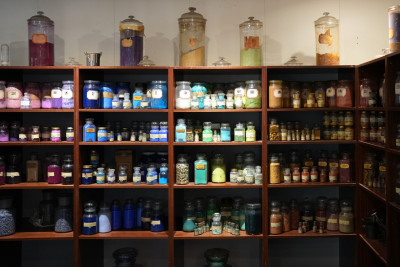
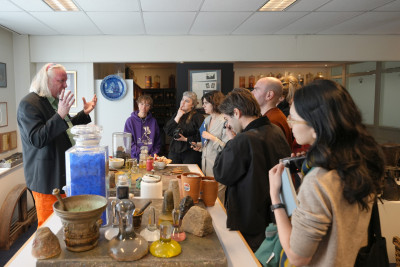
In May, the Troubling Pigments (After Polke) research group travelled to Driebergen, a town west of Utrecht, to visit the Old Holland paint factory. The manufacturer has an incredibly long history dating back to the seventeenth century, when artist guilds developed and refined their own paint recipes.
We meet Aquil Copier at the factory to learn about their world-renowned paint, its creation process, and visit the on-site museum of pigments and other paint technology objects, an archive that includes paint recipes from centuries ago, and historic and modern pigments of all kinds.
On the large roller machine is a batch of paint that seems to be just about ready. It looks like a buttery cake frosting, but with absolutely no imperfections, no sign of graininess; an almost unreal, luscious goop. The colour is A6 O-H Yellow Light, according to the Old Holland classic oil colours chart—a very subtle and pale yellow, which has a slight luminous gleam under the factory lighting. Two men are positioned on either side of the rollers, armed with palette knives. One feeds the last run of almost fine matter back through the machine with the rollers set even closer to one another, while the other rhythmically scrapes and scoops large swaths of the paint at moderate speed, depositing it, dollop by dollop, into a hefty square bucket on wheels. Every colour mixes and behaves differently, Aquil tells us, sometimes necessitating extra splash screens to be erected at the rollers when a particularly liquid mix is first transferred onto them.
At a far end of the factory floor is a room where all the pigments and other dry raw materials are stored. Stacked on shelves are large paper bags, the kind that one typically sees packaging cement mix at the hardware store. The contents here, however, are worlds away. Examining them closely one can see region labels from across the globe, charting part of their processing journey or their origin.
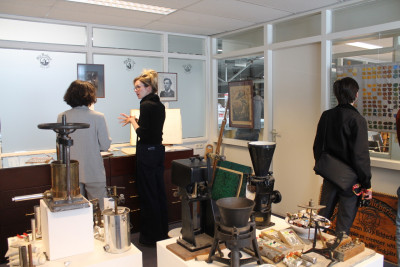
Lining one of the walls are plastic tubs that hold every colour the factory uses, easily at hand. We are able to view the powdered particles directly and are in awe of their extremely vivid chromatic qualities. Aquil shows us the difference between finer and coarser pigments and explains that some have a much greater mass than others. Each tub is labeled, and several bear “Scheveningen” in their designation—an old reference to the part of The Hague where the original factory operated, and a word that, in paint, is now synonymous with quality, like the name Old Holland.
We view a room where a couple of massive tanks of pure linseed oil sourced nearby in the Netherlands sit alongside industrial-sized scales and mixers, not unlike those used in commercial bakeries. Nearby, a station where the colour swatches for each tube of paint are hand-painted, using the very same batch of paint that will fill each receptacle. An archive of paint residue has accumulated in these factory spaces; layered brush marks slowly generate an accidental abstract on the metal shelves.
Housed inside the factory premises is a museum holding the world’s largest collection of pigments and historic paint-making tools. Here we see pigs bladders once used to store paint before the zinc tube was designed, large grindstones with old stone mullers, which disperse pigments into binders ensuring a smooth and homogeneous paint, as well as historic examples of rolling machines—achieving what a muller does, en masse and with less elbow grease—and tube filling mechanisms, both of which have hardly changed since their invention. The same designs can be seen in use on the factory floor.
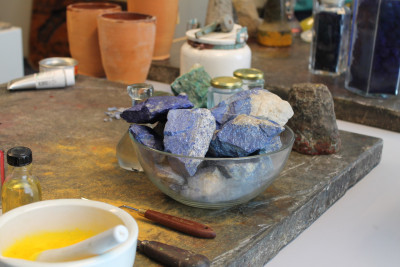
The museum holds some pigments that are extremely rare. In a few ceramic pots on a table are rolled up lengths of pure lead sheets, and the superficial accretion of white substance is clearly visible, like a secretion out of the apparently inert metal. While lead white is still allowed in many parts of the world, it has been banned in Europe for its toxicity. Nearby, a vessel holds chunks of veritable ivory black—burned elephant tusks, carbonised to lightweight shards of deep pitch black. Today, the pigment is made with burned livestock bones.
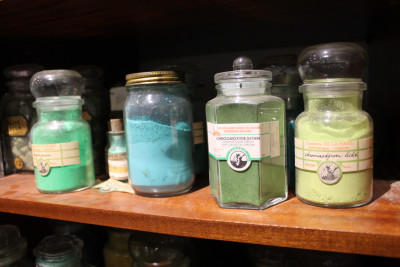
Most of the pigments in the collection are housed in a setting akin to the most wondrous apothecary imaginable; floor-to-ceiling wooden shelves are arranged with an array of glass bottles and jars, grouped by their hues in a satisfying spectrum. The labels read of countless chemical compounds, along with some more familiar terms; ‘olifant’ on a jar of pulverised black dust; a range of ‘ochres’ dominate the earthy columns to the one end of the shelf spectrum. Aquil picks up a jar with an enormous ball inside, of a turmeric orangey-yellow colour. It is a sample of Indian Yellow, the almost excessively vibrant and strong hue producing a deep, transparent yellow. He tells us that this pigment was obtained from concentrated urine from cows fed on a diet of mango leaves, which irreparably damaged their livers and caused death. Today, the main components—euxanthic acid and its derivatives—can be synthesised in laboratories.
From natural to synthetic colours and back again, our visit to Old Holland revealed how the colour industry both relies on and exemplifies the transformation of nature into artifice; a dynamic that resonates strongly with Polke’s own understanding of colour.
Melissa Waters, Master Environmental Humanities, Vrije Universiteit Amsterdam, research intern for Troubling Pigments (After Polke)
______________