
Sigmar Polke and Italy: Archival Perspectives

Sigmar Polke and Italy: Archival Perspectives

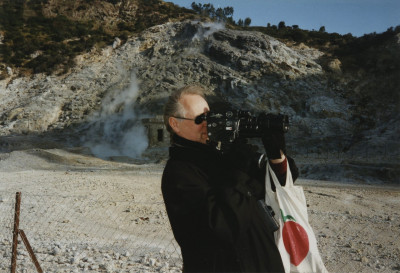
Sigmar Polke, Solfatara 1991/92 | © Photo: Bice Curiger / Archive of the Anna Polke Foundation

Like many artists before him, Sigmar Polke also undertook countless trips to Italy. In the 1980s in particular, he spent several months on the peninsula, visiting Rome, Venice, Naples, Capri, Ravenna, Pisa, and Siena, among other places.

Polke captured his impressions in photographs and on 16-mm film: The images of everyday situations, historical sites, and works of art represent independent, artistic reflections on his experiences. At the same time, they illustrate that Polke was just as interested in everyday scenes and personal encounters as he was in the country’s historical painting traditions and visual worlds.

The latter find their way directly into Polke’s work as visual references: To this end, the artist drew upon the canon of so-called high culture as well as pop-cultural motifs without regard for supposed hierarchies, referencing ancient iconography just as much as contemporary sources. By appropriating these motives, transforming them, and placing them in new contexts, he created new layers of meaning and challenged conventional ways of seeing.
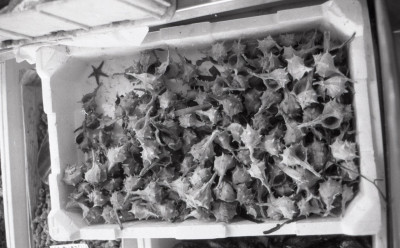
Britta Zoellner, Purpurschnecken, 1986 | © Britta Zoellner / Archiv der Anna Polke-Stiftung

Italy also gave Polke access to historical materials and techniques, which he reinterpreted for his own artistic practice. For example, a visit to the Stazione Zoologica in Naples in 1986 inspired him to extract purple dye from sea snails himself—an experiment documented through photographs and a film, that enabled him to create Purpurtuch (Purple Cloth), which was incorporated into the Athanor installation.

The Istituto Italiano di Cultura di Colonia is presenting two display cases curated by the Anna Polke Foundation: One illustrates Polke’s thematic references and traces his trips to Italy in the 1980s through selected archival materials. The other focuses on Sigmar Polke’s contribution to the 42nd Venice Biennale in 1986. The Athanor installation, which won the Golden Lion, serves as the starting point and point of reference for the other two presentations on display:
> Stefanie Pluta, Scenario for a Crystal
> Francesca Valentini and Fabrizio Saiu, Echoes of Athanor

Curated by Elsa Wellmann-Gilcher with Kathrin Barutzki (Anna Polke Foundation).

Sigmar Polke and Italy: Archival Perspectives
Display Case Exhibition, 13 July–20 November 2026
Istituto Italiano di Cultura di Colonia, Cologne